The phone rang in the middle of the night. Recognizing my son’s number, I quickly sat up in bed and answered. “Mom, I need your recipe for those ‘little chickens’ you make for Valentine’s Day.” He said as soon as he heard my voice. “Little chickens?” My sleepy brain was confused, “This is the emergency you woke me up for?”
This story never fails to get a laugh when I share it with an audience. But as I continue with the story, it drives home the point that you are never too old to need a mom in your life, whether you want a recipe or face a life-or-death emergency. This story conveys the lifelong importance of adoption much better than any other facts or data possibly can do.
You’ve probably been in these shoes. You have an important message. You’ve distilled it to the 3-5 most important points. You want your readers to reflect upon it, remember it and be transformed by it. Telling stories that connect heart, mind and spirit is one of the most effective ways to do this.
Consider Biblical truths that have stuck with you over the years. If you’re like me, many are drawn from the parables of Jesus. The gospels record more than three dozen parables spoken by Jesus! In both the old and new Testaments God used story upon story to demonstrate his love, messages and expectations for us.
Here are my top three tips for using stories to convey deeper messages:
Be Specific: Bible stories are both local and universal, time-specific and timeless. God’s stories involve everyday people doing everyday things. Each story-teller from Genesis through the New Testament told stories that fit into the historic, geographic, political and cultural context of the immediate listeners. Your stories will resonate with your readers when you set them in a “time and place” context that is specific, concrete and relatable to day-to-day life.
Be Purposeful: Knowing your purpose for sharing a particular story will help you determine the length, structure and details to include. If your goal is to teach an important point that you want your readers to remember and reflect upon later when facing challenging real-life situations, your story should offer a memorable visual picture while also evoking strong emotions that touch the heart.
If the purpose for your story is to motivate your readers to take action, your story has to demonstrate the impact of the desired actions. When I write about the impact of trauma on children, one of my goals is to motivate readers to do something different when they see behaviors that might possibly be triggered by trauma. I use stories that show – not tell- both the “before” and “after” effects on a child. I want the reader to walk away with the thought, “I could do that too.”
Have fun: Your reader will enjoy your stories a whole lot more if you enjoy them first. Be playful, have fun, smile as your write. The more that you actually like your characters and their activities, the more your readers will relate to them and look forward to reading the next sentence, paragraph and page.
Try to keep with Sue,drop by here Website:http://suebadeau.webs.com/
Thursday, June 18, 2015
Accuracy,Perspective,Atheists,and Christians-Joseph Max Lewis
"This is outrageous and demonstrates the danger of permitting religion in the public square," Liebowitz said. "History teaches us, or should have by now, that wars caused by religion, and especially Christianity, have killed more people than all other causes, combined."
"I'm afraid that's not accurate. Stalin, Mao and Pol Pot each killed millions and they were all confirmed atheists. Remember the Great Peoples Cultural Revolution? Over twenty million died before it was over. The killing fields in Cambodia claimed the lives of unknown millions, but some estimates suggest twenty five percent of the country's population died at the hands of the Camere Rouge. Joseph Stalin starved ten to twelve million Russian peasant farmers to death and killed another two million building the great Canal outside of Moscow. All three of these monsters were confirmed atheists . . . Probably five thousand people were killed during the Inquisition. In America, thirteen were put on trial during the Salem witch trials. Horrible and indefensible, no doubt. But millions of human beings were slaughtered by Stalin, Pol Pot and Mao. I'm afraid we Christians are amateurs compared to you atheists."
- from the novel "Separation of Church and State."
Joseph Max Lewis josephmaxlewis.com author of The Diaries of Pontius Pilate, Separation of Church and State and Baghdad Burning.
http://www.facebook.com/pages/Joseph-Max-Lewis/390366621022306
http://www.amazon.com/-/e/B008ZHHUBW
Joseph Max Lewis served as a member of an Operational Detachment in the U.S. Army's Seventh Special Forces Group, the storied Green Berets. During his service Lewis received antiterrorist training and his detachment was tasked to "Special Projects." Afterward, he served as an instructor at the Special Forces Qualification Course. Lewis attended the Pennsylvania State University, where he was elected to Phi Beta Kappa, the University of Tel Aviv in Israel, and the University of Pittsburgh, receiving degrees in International Politics and Law while being certified in Middle East Studies.
After living and studying abroad, first in the Middle East and then Southeast Asia, Lewis returned home to practice law. He’s a columnist in the New Bethlehem Leader-Vindicator and author of The Diaries of Pontius Pilate, Separation of Church and State and Baghdad Burning. He currently lives, writes, and practices law in and around Pittsburgh, Pennsylvania.
Wednesday, June 17, 2015
Tony Hilling-THE HOLINESS OF GOD
In the book that I recently have published, “The Voice of Aedistamen”, there is a character in the story called, “the Ghaedish-Mor”. This name may sound a little weird and wacky to our generation. In fact, you may say that I take a kind of perverted, Celtic delight in producing guttural words that no one else can pronounce (at least those who are half ways familiar with the tongue of Shakespeare). The name derives from the combination of a Semitic word, “kadosh” meaning holy, and a Gaelic word, “Mor”, meaning, great or large. The appellation then describes the God of the enslaved people as the Holy One, or the Holy-Great One. Clearly, there is biblical reference here to the God that Isaiah calls, “the Holy One of Israel”.
Lately, I have felt drawn to the book of the Bible that we call, “Leviticus”. It’s a book that describes in great detail the regulations for the worship of the Holy One of Israel, and for that reason can seem very dry to our culture that tends to be long on freedoms but short on accountability. However, if we look a little deeper into the foundations of this book we see God reminding His people that He is a Holy God and that their lives must reflect that Holiness. In chapter 19:2 of the book, God says: “You shall be holy, for I, the Lord Your God, am Holy.” Later, in the fifth book of Moses, Deuteronomy 32:51 & 52, Moses is reprimanded by God and is refused entry into the Promised Land, “…This is because …you broke faith with Me in the presence of the Israelites …because you did not uphold my Holiness among the Israelites. Therefore, you will see the land only from a distance; you will not enter the land I am giving to the people of Israel.” This may seem very harsh to us today, after all that Moses went through to bring the Chosen People out of Egypt and to the very shores of the Jordan. You might think that God was unfair in treating him so. But this event described in Numbers 20: 9-11, clearly shows Moses questioning God rather than trusting in Him; undermining God’s holiness rather than upholding it. There is a lesson here for all of us believers and especially those who are in leadership over Christian communities: we must, by our lives, hold up before the world the Holiness of God. This is quintessentially expressed in the Cross and Resurrection of God’s Only Son, Jesus Christ. Nothing else will avail; “no power of hell nor scheme of man.” Only the Holiness of God can save us.
I have sensed in my own life a call to hold up God’s Holiness today. Therefore, this is a major theme in “The Voice of Aedistamen”, where the God of the enslaved people, the Ma’apone, begin to turn back to Him as they seek freedom. I have also written some songs that reflect this motif. One of them is entitled, “That Towering Cross”, a meditation on a play by the same title by an influential young writer, Andrew Kooman. I believe this a call for all Christians today, to hold up once more the Holiness of God in our communities, using whatever gifts God has given us to do this. Will you join me in this quest? There will be cost to this; it will almost definitely put us “in harm’s way”. But we will have the peace of knowing that our confession of Christ has been empowered in action; that the faith expressed in our words has been visible in a changed life.
Tony Hilling is a retired pastor living in Western Canada. You can connect with him at:
https://twitter.com/TonyHilling
https://www.facebook.com/tony.hilling
https://plus.google.com/u/0/
https://ca.linkedin.com/pub/tony-hilling/44/22/3a3
Don't get in a RUT,change things up a bit-James J. Griffin
Writers and readers both need to take the time to stretch their imaginations and change
their habits, or they risk getting in a rut.
I've written Westerns, and Westerns exclusively, for years now.
However, I've recently done a Christian themed Western THE FAITH AND THE LAW, and have branched out
into Young Adult Westerns, with my LONE STAR RANGER series. I've even done a short
Western romance, HEART OF HER RANGER. And I've just finished my first contemporary
murder mystery, THE MAD MAN OF THE MOUNTAINS. However, Westerns are still my
first love, and what I'll continue to write. But trying different genres helps stretch my
imagination, and will bring some fresh viewpoints to my writing. So, writers and
readers, step back, take a break from your usual genre, and see where you end
up.
You might just be very pleasantly surprised.
James J. Griffin, while a native New Englander, has been a student of the frontier West from a very young age. He has travelled extensively throughout the western United States, and has visited many of the famous Western frontier towns, such as Tombstone, Pecos, Deadwood, Cheyenne, and numerous others.
Jim became particularly interested in the Texas Rangers from the television series Tales of the Texas Rangers. Jim's deep interest in the Texas Rangers led him to amass an extensive collection of Texas Ranger artifacts, which is now in the permanent collections of the Texas Ranger Hall of Fame and Museum in Waco. (Jim told his story and it was published in Issue 21 of the Texas Ranger Dispatch (page 35) The Dispatch is the official publication of the Texas Rangers Hall of Fame & Museum)
Jim and Yankee Jim & Yankee
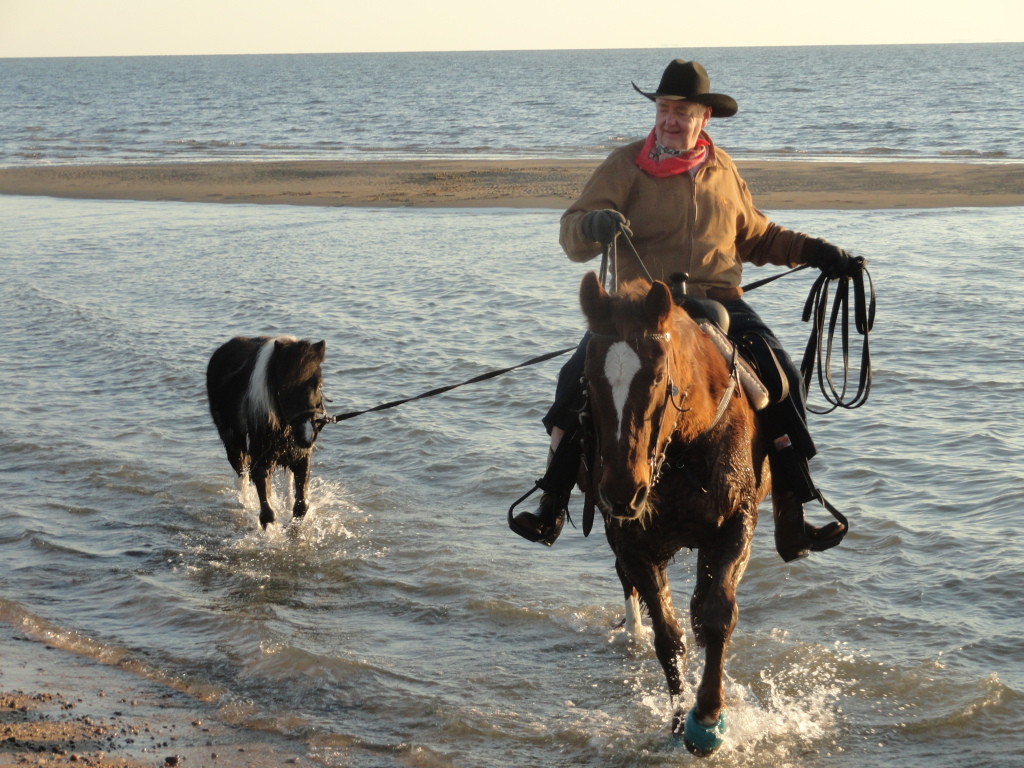
Jim has also been an avid horseman all of his life. He bought his first horse, a pinto, while he was a junior in college, and has owned several American Paint Horses, including his current mount, Yankee. He is a member of the Connecticut Horse Council Volunteer Horse Patrol, an organization which assists the state park rangers with patrolling the state parks and forests.
At the urging of James Reasoner, author of Texas Wind and The Civil War Battle Series, plus many other novels, Jim decided to write a series of Texas Ranger novels. The first book, Trouble Rides the Texas Pacific, was published in 2005. With the success of that book, Jim was encouraged to continue his writing.
Jim's books are traditional Westerns in the best sense of the term, with strong heroes who have good moral values. Highly reminiscient of the pulp westerns of yesterday, the heroes and villians are clearly separated with few shades of gray. No anti-heroes to be found here.
While Jim's books are fiction, he strives to keep them as accurate as possible within the realm of fiction. To that end, besides his own travels and research, he relies on his good friend Texas Ranger Sergeant Jim Huggins of Company F in Waco for forensics and Ranger technical information, and good friends Karl Rehn and Penny Riggs of KR Training in Austin, Texas for their expertise on weapons and ammunition of the frontier West.
Jim is a graduate of Southern Connecticut State University. When not travelling out West, he currently divides his time between Branford, Connecticut and Keene, New Hampshire.
Jim is available for presentations and book signings.
Drop by Jim's Website:http://www.jamesjgriffin.net/index.html
An Overview of Who I am and my WORK- Larry Peterson
Since this is my first time posting on the HHP Blog I thought I would simply give you an overview of who I am and my work. I have one published novel, The Priest and The Peaches, a fictionalized account of the early years of me and my siblings. We had lost our folks and it was an interesting ‘ride” trying to keep the family together. The sequel , The Demons of Abadon, should be out sometime in the fall and that delves into the paranormal. I also have another book, “Horizon Homeless” which is in its final draft. This deals with a family who, through no fault of their own, find themselves on the road to “homelessness”. Lastly is my children’s book, Slippery Willie’s Stupid, Ugly Shoes”, which deals with the differences among kids. I also have written over 500 blogs doing commentary on such topics as The Holocaust and Catholic/Christian persecution.
As far as my writing is concerned I just go at it. Writing a novel can be torturous. I have an idea and, for me, it is like I am back on the streets of NYC as a kid dodging in and out of traffic and never knowing what to expect but somehow miraculously surviving and making it back home. I don’t plot or synopsize or outline until “after the fact” because I don’t really know where I am going. But, bottom line, it is always a fun ride and I always seem to reach my destination albeit unexpected. I am what is known as a “pantster” (unorthodox) in my approach to writing fiction. I would definitely flunk a college course in “Intro to Novel Writing; 101”.
There is one facet of who I am that I do take very seriously and that is my faith. I am a “cradle Catholic”. As a Christian man I am appalled at how the narrative seems to have shifted where Christians are now being dubbed “intolerant, racist and homophobic” because we do not believe in certain secular ideas. The last I heard this is still the USA and you can believe what you want. The point is, I have found myself trying to post every day, at minimum, a quote from the Bible or a respected religious icon (Pope Francis, Billy Graham, Mother Teresa etc.) on Twitter and Facebook just to defend the faith I love. I also write commentary on some of these “hot button” topics. I’m just a little pebble on a very big beach but at least I can try to get into some folk’s sandals now and then.
Finally, as all of you have had, I too have had a share of “bumps in the road”, mostly cancer(s). My Mom died 55 years ago from leukemia. Back then you did not last long. She lasted four months. My first wife died of melanoma 12 years ago. My sister had lung cancer but is OK after having a lung removed. My second wife, (we are married eight years) came down with Lymphoma in 2011 and now she has Alzheimer’s Disease. I am her primary caregiver and every day is an adventure. Last but not least—I am a Prostate cancer survivor (had a radical prostatectomy eight years ago) and I also have lived with MS for 30 years. Bottom line –I am doing GREAT!!! Praise the Lord. Next week I will be 71. For me, it is my new 51.
Glad to be here. http://www.slipperywillie.blogspot.com
What the Music Festival Taught Me About Writing-Janice L. Dick
I spent the past week sitting at our local music festival listening to four of my granddaughters participate. Even though I’ve attended many such festivals and participated in a few, I now realize that some of the lessons learned can also apply to writing:
1. Practice makes perfect, or nearly so.
The adjudicator suggested that students need regular practice. No surprise there. In her words, “You only need to practice on the days you eat.”
Sigh. If I “only” wrote on the days I ate, I’d get a lot more writing done. Although we all must create a schedule that suits us, the truth is, the more we write, the better we become.
2. A steady and consistent rhythm comes from the heartbeat of the soul.
Some of the participants in the music festival played all the right notes, but theirs was a “learned” performance. Others made a mistake or two, but the music had a steady rhythm, because it came from the soul.
Some writers have an innate gift for story and composition, while others of us must struggle to create a solid piece of writing. Either way, the story communicates best when it comes from the heart.
3. Our attitude colors our performance.
One of my granddaughters has an especially dramatic bent. Her mother warned her that even if the performance didn’t go as well as she hoped, she was not allowed to bang her head against the piano, Muppet style.
I chuckled at that, but how often do we belittle ourselves and our writing when we feel we’ve come up short? We need to have an attitude of professionalism and acceptance of failures as well as successes. Call it literary poise.
4. Life must be consistent on and off stage.
One of the performers suffered a memory lapse during her piano piece (she was not the only one, but her reaction was unique). Instead of simply asking for her music book, she ran her hands through her hair, jumped up from the bench, jogged over to pick up her music, jogged back and plunked down on the bench with a huge sigh to try again. The adjudicator suggested that performance did not only include the actual playing time, but the total spotlight time.
As writers who are Christian, we are “on display,” not only when people read our work, but also when we go to the grocery store, or the bank, or a sports event. Consistency and integrity are key.
5. You are you, unique in style and voice.
Several times during the music festival, two children played the same piece, but it didn’t ever sound the same. Each person (or teacher) interpreted the music in a unique manner. Neither was right or wrong, just individual.
Writing is an individualistic vocation if anything is. We interpret our world and report on it or show it through our characters. However we choose to do this, we must be true to ourselves.
Blessings as you keep living and writing consistently.
Janice Dick began writing intentionally in 1989. Her historical trilogy was released in 2002, 2003 and 2004, the first two books winning First Place in the Canadian Christian Writing Awards, and the third being shortlisted for the same. Besides writing historical fiction, she has also crafted devotionals, inspirational pieces and book reviews, and put in many hours of editing, mentoring, and speaking (workshops, presentations, readings). Her first contemporary fiction manuscript awaits either publication or extensive revision, and a new historical fiction series was just released (October 2013).
Janice was born and raised in southern Alberta, Canada into an ethnic Mennonite farm family. She was blessed with a loving and stable childhood, and lots of relatives who told stories of Russia, emigration and early life in Canada. After graduating from high school, Janice attended Bible college in Saskatchewan, where she met her future husband. They moved to a farm in central Saskatchewan after their marriage and raised three children there. They are now grandparents to ten amazing kids.
Drop by Janice's Amazon Author Page:http://www.amazon.com/Janice-L.-Dick/e/B001KIAKLK/ref=sr_ntt_srch_lnk_1?qid=1434573273&sr=8-1
Print Journalism taught me HOW to look for STORIES - Kevin Stabinsky
While college taught me writing basics, my time as a print journalist taught me something even more valuable: how to look for stories.
While the perception of military life tends to be one of excitement, it isn’t always the case. Even initially exciting events such as a new type of training can get boring when they are integrated into the normal routine. Additionally, because most of a military journalist’s stories appear in military publications (base newspapers, Army produced magazines, etc.), the audience isn’t necessarily interested in reading about training or other things they probably experience firsthand themselves.
Despite all these difficulties, my job was to produce weekly content to tell the Army story. So I was forced to look for new story angles and human interest stories. I had to look deeper than the surface. I was forced to look for small details that are often overlooked and expand upon them, to look for human interest angles that would make others want to read what I wrote.
I credit this attention to detail and deeper digging to the completion of my first novel. I think all of us have stories to tell; however, we may not necessarily have the skills to pick out the ones worth telling, losing them in the sea of everyday life. Army life taught me this skill.
Because my first novel deals with Army life to an extent, I hope I do a good service to “the service” for all it has taught me about being an effective storyteller. Likewise, I hope to continue to use and develop this skill as I continue to grow as a writer.
To follow me on this journey, follow me at:
My Blog: http://kstabinsky.blogspot.com/
Facebook: www.facebook.com/kevin.stabinsky.3
Twitter: https://twitter.com/kevinstabinsky
Thursday, June 11, 2015
Please welcome Kevin Stabinsky to the Helping Hands Press Author Community!
I became interested in writing during my freshman year in college (fall 1998). I was deeply involved in playing Ancient Anguish, a text- based fantasy multi-user dimension (MUD) game. One of the perks of completing enough quests in the game was the opportunity to become a coder for the game.
The joy at seeing my creation come to life got me interested in the creative process, so I decided to pursue a degree in creative writing from Penn State University. I joined the Penn State Schuylkill Campus Collegiate staff, interned at PA Business Central and Voices of Central Pennsylvania, and became a summer correspondent for the Pottsville Republican.
In Dec. 2002, I graduated from Penn State University with a B.A., English, with an emphasis in nonfiction writing. Following graduation, I enlisted in the Army as a print journalist. During my roughly 6 years in the Army, I covered multiple story types (sports, hard news, features), earning several awards. My work has appeared in multiple newspapers worldwide to include Military.com (readership: 6,023,048); Stars and Stripes, Washington, DC (readership: 1,000,000); and the Associated Press, New York, NY. One of my stories, Girl Waits for Second Chance to See, made the front cover of Stars and Stripes.
My work in the Army garnered me numerous awards, including the 2007 U.S. Army Forces Command runner-up Journalist of the Year (one of the top 14 journalists Army wide), 2005 Installation Management Southwest Region Journalist of the Year (one of the top seven journalists Army-wide). Other individual Army awards include editor of the 2007 top Army field publication, second place in 2007 for story series, and second place in 2006 for feature articles.
After completing my contract, I continued to work for the Department of Defense, winning the 2009 Army Civilian Journalist of the Year award.
I am also a graduate of the Christian Writers Guild and have had work published in devotionals such as Soul Journey. I am currently in the process of reediting my second novel to prepare it for publication, and have several other ideas for future projects in the works.
Drop by Kevin's blog and say hello:http://kstabinsky.blogspot.com/
Also find him on Twitter:https://twitter.com/kevinstabinsky
and Facebook:https://www.facebook.com/kevin.stabinsky.3
What do you think of the beginning of Larry Peterson's YA Fantasy "The Demons of Abadon"?
PRELUDE
The Darkened were blackened souls filled with hate who had chosen to reject goodness in life. Upon leaving their earthly bodies they moved into a world absent of hope. It was the most dreadful place to be. Scorched and dark, it was steaming hot and never ending. The worst part was, this place was devoid of second chances. This caused the hatred inside the Darkened to burn like a white-hot, unquenchable fire. If only they could have said just once, “I’m sorry, please forgive me.”
They had their chances---so many, many chances. But, before anyone or anything, their choices were always for themselves first. Self-serving pride always trumped humility, from the time they reached the age of reason until they breathed their last.
Once a person’s soul had joined the ranks of the Darkened they were ordered to prowl about the world seeking new recruits. Many potential recruits, already weakened by their own love of self, chose to follow the Darkened’ s incessant nagging and embraced worldliness before all else. Gluttony replaced temperance, sloth conquered diligence, wrath smothered patience, lust ridiculed chastity, and most importantly, pride trounced humility. These were the folks who had pledged their very souls to Satan. In the world of Invidia they were known as the Ergots.
The Ergots were the future Darkened and would graduate to that existence upon their deaths. All they had to do while alive was absorb the hate from the Darkened Spirit assigned to them and then be in the forefront of all that was ungood among the living, spreading the terrible lie that the love of self was virtuous. Their rewards for pledging themselves included an extended healthy life filled with many earthly pleasures. Rarely did anyone seek atonement and ask forgiveness.
Amazingly, Satan and his Darkened despised and hated the Ergots. It did not matter that they were the ones doing their earthly bidding. They were hated and despised because they still had a very slim chance at redemption. That was something even Satan could never have and there was not one thing he could do about it.
The Great Festival of Torment took place every 100 years. On this night the Darkened would join together with the Ergots in a spiritual hate-fest. They would come together from all parts of the world to gather at the gates of Invidia to proclaim the millions of new Darkened who had joined the army of Satan over the past century. The highlight of the “Great Festival” was always “Sacrificium Humani Agnus” (Latin meaning, “Sacrifice of the Human Lamb”). This was an offering to Satan as tribute. Somewhere on the planet there was a young person that had been nurtured and kept pure since birth to be that Lamb. The last Great Festival had been in 1866. It was time for another.
Larry Peterson Sr is an author and Catholic/Christian blogger and has written over 500 blogs. He was born and raised in the Bronx and moved to New Jersey when he got married. Eventually he and his family settled in the Tampa Bay area of Florida. He started writing newspaper commentary in the late 1980’s.
His books include the novel, The Priest and the Peaches” and the children’s book, “Slippery Willie’s Stupid, Ugly Shoes”. He is in the final draft of his latest book, The Demons of Abadon, which is the sequel to The Priest and The Peaches.
Larry’s first wife died of cancer (Melanoma) in 2003. He married again in 2006. His new wife also had been widowed. Ironically, she came down with cancer (Lymphoma) in 2011. In the fall of 2014 she was also diagnosed as having early onset Alzheimer’s Disease. Larry says, “We are both doing fine. Having Faith is a beautiful thing.”
Where can you find Larry?
Website/Blog: http://www.slipperywillie.blogspot.com
Amazon: http://www.amazon.com/Priest-Peaches-Larry-Peterson
Goodreads: www.goodreads/LarryPeterson.com
Twitter: https://twitter.com/slipperywillie
Facebook: http://www.facebook.com/larrytpbx
Coming Soon,6/25, Murray Pura's American Civil War Series "Cry Of Freedom The Complete Ebook"
The plantations. The Underground Railroad. Chancellorsville. Vicksburg. Gettysburg. Little Round Top. Chickamauga. Chattanooga. Missionary Ridge. The soldiers in the field. The families at home. The nurses in the hospitals. The speeches at Richmond and Washington. The prayers in churches North and South. It’s all here in one of the most dramatic series ever produced.
Join us for one of the most exciting events in American inspirational publishing – Helping Hands Press presents CRY OF FREEDOM!
Murray Pura was born and raised in Winnipeg, Manitoba, Canada, just north of the Dakotas and Minnesota. His first novel was released in Toronto in 1988 and was a finalist for the Dartmouth Book Award. Since that time he has published ten more novels, two collections of short stories, and several nonfiction titles including the Zondervan books Rooted and Streams and the Baker devotional Majestic & Wild. He has been a finalist for several awards in the US and Canada and in 2012 won the Word Award of Toronto for Best Historical Novel. Murray lives and writes in southwestern Alberta and is currently published by Barbour, Baker, Harper One, Zondervan, and Harvest House - he works with publishers in Canada, America, the UK, and Holland. His releases for 2013 include the novels: Ashton Park, The Rose of Lancaster County, A Road Called Love, Seven Oaks, The Painted Sky, Whispers of a New Dawn, Beneath the Dover Sky, The Name of the Hawk, and An Amish Family Christmas. His diverse writing spans many genres including: historical fiction, contemporary fiction, literary fiction, romance, adventure, western, suspense, fantasy, Amish, and inspirational. Most of his work is available in ebook format for Kindle, Kobo, and Nook as well as in paperback.
Tuesday, June 9, 2015
Spice of Life in Tel Aviv - Marta Burden
Spice of Life in Tel Aviv
Five sheck-el. Five sheck-el. His voice booms over the din. Hebrew mixes with English, Farsi with French. Mizrachi music weaves in and out of conversations. “What did you say?” You lean in closer to your companion, mouth to ear.
Wednesday evening at the HaCarmel shuk in Tel Aviv. It’s a crush of humanity––not for the faint of heart. Permanently planted on HaCarmel Street at the junction of Allenby, King George, and Sheinkin Streets, this market fills the needs of shoppers as well as the lonely heart wanting more than four drab walls of an apartment.
Stalls of fresh, vibrant fruit and vegetables of every color––large and plump displayed in inviting sections beckon. “Come, taste, touch.” You’re pulled along by the crowd deeper in. Pungent spices in buckets fill a metal table and offer a fusion of color and aroma. Next door, glossy olives and pickles compete for the senses, and next to that––fresh local and European cheeses. Dried fruits, fresh flowers, teas, coffee, and honey, a feast for eyes and tongue. Then you peek down a side street and another odor hangs in the air. You’ve found the meat and fish. Plastic tables are filled with ice and the catch of the day. A small cubicle inside a concrete building holds a refrigerated case filled with chicken and slabs of beef and lamb. An old fashioned butcher, if you will. You go around the corner, down another alley, past more meat markets and back into the stream of bodies on the main thoroughfare. Tucked between the cubicles of clothes, school supplies, tchotchkes with little value, Shabbat candles, challah covers, shoes and cooking supplies, reside fresh fruit juice stands and shawarma shops. The pop and sizzle of meat on a flat iron grill beckons you to stop, point to the salad and sauces you want to fill the thick soft flatbread sandwich filled with hot shaved lamb and turkey. No respectable shawarma walks away without a sizeable topping of thick-cut steak fries to finish the deal. With a wrap of white paper to hold the meal in place, you’re on your way further up and further in, to look for the best price, the freshest produce, the newest music.
Skimpy shorts and tank tops pass by long black skirts and wigs. Tourists mingle with long time residents. Babies in strollers to wrinkled Babushkas - everyone’s there.
This is the spice of life in Tel Aviv.
Drawing from her many visits to Israel, Marta seeks to bridge the gap between the Christian and Jewish world.
You can visit Marta at: verbalismbuffet.blogspot.com
Or on Twitter: @MartaBurden
Thursday, June 4, 2015
Trivia Time: Who would like to WIN some incredible ebooks?
Who would like to WIN some incredible ebooks?
Answer the trivia question correctly and we will gladly send you all of the ebooks in the "Just the #1's" ebook package.
Ready for the question?
Please use the "Contact Form" on the sidebar of the HHP blog to send your answer in. Thank you!
Here is the trivia question:
The first gold strike in the Old West was made by WHO? in What Year, and in What Town?
Subscribe to:
Posts (Atom)